
MBA and Master of Business Administration programs at UK Universities
In this article, we will discuss the differences between MBA and Business Administration master's programs and provide a roadmap on which path might be more suitable for whom. We hope it will be helpful. If you have any questions about your career plan or other details, please do not hesitate to contact Edukas consultants.
Despite advancements in technology, business administration and its subfields remain relatively popular compared to engineering and similar programs. There may be many reasons for this, but regardless of their chosen field of study, students continue to incorporate a business background into their career plans at some point, from an academic perspective.
Business programs at UK universities already offer a broad range of expertise, encompassing key business areas such as leadership and management skills, strategic thinking and decision-making, finance, marketing, accounting, operations, and human resources. It's also worth noting that these universities consistently rank highly in global rankings. Furthermore, master's programs not only provide an academic foundation but also incorporate real-time projects, offering students the opportunity to collaborate with strong industry companies. This robust and practical program content allows students to develop connections with the industry rather than solely focusing on academia.
What is an MBA? Who is it suitable for?
MBA is an abbreviation for Master of Business Administration, which translates to 'İşletme Yönetimi Üst Lisansı' (Master of Business Administration) in Turkish. It is one of the most popular and well-known programs worldwide. Offered by the majority of universities in the UK, these programs may not be suitable for everyone.
The goal of MBA programs is to equip graduates with the management skills necessary to advance to higher positions, particularly in the business world. Therefore, most MBA programs require at least two years of work experience in a managerial position, in addition to academic and language proficiency. It's worth noting that there are also MBA programs that do not require work experience. Furthermore, it's important to remember that most universities require pre-admission interviews, which are a crucial part of the admissions process.
Who should get an MBA?
- In a different field undergraduate education those who have received this education and wish to continue their career journey in a managerial position, and those who want to develop themselves in this field.
- Professionals who already have a certain level of experience
- Those with an entrepreneurial spirit and who want to enhance their careers through entrepreneurship.
What are the advantages of an MBA?
- To be able to continue a career in higher positions
- Salary Increase
- Sector/Role Change Opportunity
- International business connections (Network Development)
- International experience in both education and social life.
- Developing management skills
Business Administration and Related Master's Programs
Business administration programs at UK universities are very popular at all academic levels (undergraduate, postgraduate and doctoral) and are open to international students, continuing to be highly sought after.
These programs aim to provide both global and micro/macro perspectives, and generally include core sub-disciplines such as trade and economics, strategic management, marketing, human resources management, finance and accounting, supply chain management, entrepreneurship, data analysis and its proper use, communication, and leadership.
While the education system is highly practical, it heavily incorporates case studies from globally respected sources (Harvard, Deloitte, Boston Consulting Group, etc.).
Additionally, some universities in this field offer the opportunity to complete a real-time project called a Consultancy Project during the thesis period, upon the student's request. This allows students to collaborate with a suitable firm on a project, report on it, and earn their diploma. Many UK universities also offer students the opportunity to build strong professional connections through partnerships with well-known firms in the industry (such as PwC, KPMG, HSBC, and Amazon).
The program content focuses on theory, presentations, projects, and group work, and it blends both scientific and practical aspects very well. The aim is to train professionals who combine strategic thinking with analytical thinking, providing a different and high-quality perspective to the sector.
In comparison to MBA programs, these programs do not require work experience in addition to academic and language proficiency. Similarly, some programs allow students to pursue a master's degree in Business Administration even without an academic background, meaning they can do so after completing an undergraduate degree in an unrelated field. In other words, students can build their careers by combining their education in two fields, regardless of their undergraduate major.
Who is it suitable for?
- Recent graduates (students with limited or no work experience)
- Those who want to combine their existing undergraduate education with management skills.
- Those who want to understand the field of Business Administration in all its dimensions (business resources, marketing, entrepreneurship, etc.) and develop themselves in this field.
EDUKAS CASE STUDY:
To give an example from students we've placed in previous years, Seda, a final-year International Relations student at a university in Türkiye, contacted an Edukas consultant to pursue a Master's degree in the UK. After preparing the necessary documents, they had meetings to discuss the programs and universities she would be applying to. Seda was determined to pursue a Master's degree in Business Administration, but was researching MBA programs. Her consultant explained that Business Administration-focused programs would be suitable for her, both because she lacked work experience and because her background aligned with Business Administration, making it suitable for her career planning. However, despite all the insistence, Seda only applied to one university on her list, specifically the MBA program, and since the Edukas consultant didn't want to disappoint her, she completed her applications that way. In approximately two months, Seda received acceptance from almost all the programs she applied to, except for the MBA program, where she received a suggestion to choose an alternative program. This feedback indicated that she was not suitable for the MBA program and that she should choose a Business Administration or similar program to continue the evaluation process. That day, Seda told her Edukas consultant, "Yes, you told me exactly what you said," and continued her process by choosing her alternatives. If you, like Seda, want your process to continue smoothly and without problems, be sure to contact our experienced Edukas consultants and take advantage of our free support to ensure you are making the right investment in your career journey.
Differences Between MBA and Business Administration Programs:
- While MBA programs may require work experience, Business Administration programs do not.
- While MBA programs are suitable for professionals who have advanced in their careers and are aiming for management positions, Business Administration programs are better suited for those who want to gain entry into the business world.
- MBA programs focus on strategic leadership and cover senior management skills, while Business Administration programs teach management fundamentals, such as marketing, human resources, operations, etc.
- While MBA programs open doors to opportunities such as career advancement, increased professional connections, and career changes, Business Administration programs provide a strong foundation and offer a good entry point into the workforce for recent graduates.
- In general, MBA programs at UK universities are more expensive than general Business Administration programs; program fees are somewhat higher, and scholarship opportunities are more limited or only available for MBA programs.
In summary, while MBA programs are necessary for professionals with work experience seeking management and promotion opportunities, Business Administration programs may be more suitable for recent graduates and those looking to explore their careers. If you wish, we can get to know you based on your career goals and personal expectations and together determine which path is right for you. Simply fill out our contact form.
EDUKAS MBA DAYS
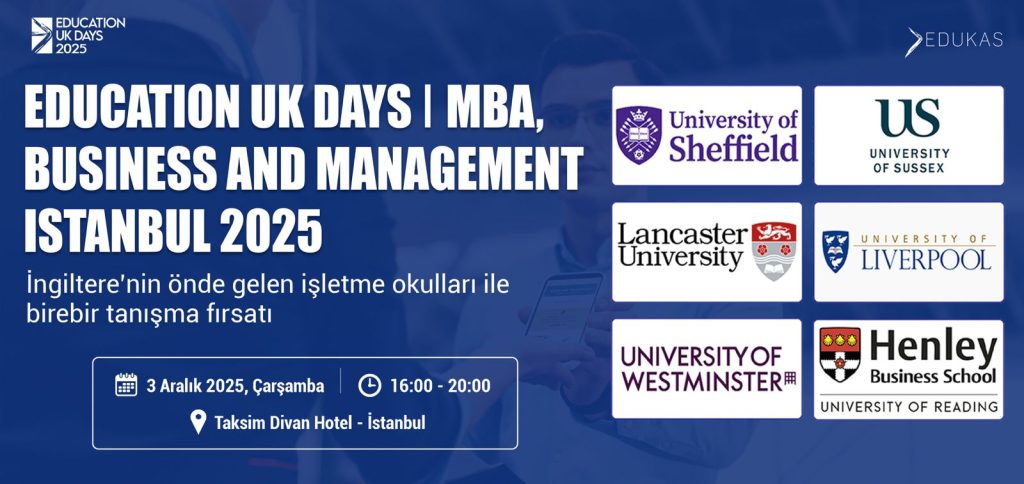
Edukas, the Official Representative of UK Universities, continues to bring prospective students together with universities in the United Kingdom, as it always has. On Wednesday, December 3rd, At Taksim Divan Hotel They are organizing a fantastic event where you can discuss the topics mentioned above, plan your MBA, and meet with academics from various universities. The event is free, and you will be able to receive one-on-one information from academics and staff from prestigious business schools.
Event information and registration form here .
Frequently Asked Questions
What are the course contents and how do they differ?
MBA programs include management-focused courses, while Business Administration programs offer course content encompassing business and commerce-based subfields (marketing, finance, accounting, communication, etc.).
What are the admission requirements for both programs?
MBA programs require work experience, although some universities may not; for this, be sure to contact your Edukas consultant. Work experience is not required for Business Administration-focused programs. Additionally, MBA programs may request an interview during the application process. Interview performance may be a factor in acceptance. For both programs, an internationally recognized English language proficiency certificate (IELTS, TOEFL, etc.) must be submitted.
Will I have difficulty finding a job if I don't get an MBA?
If you're not a suitable candidate for an MBA, you're more likely to struggle unless you choose an alternative path to self-improvement. With the right program choice, success and rapid career advancement are inevitable.
What are the opportunities after graduation? Is it possible to work in the United Kingdom?
Whether you choose either program path, the conditions and process for obtaining a post-graduation work permit are exactly the same. Similarly, the scope and conditions for obtaining a student visa are identical for both programs.
Do both programs last one year?
Both programs generally last one year at UK universities, and the diploma obtained is equivalent to a Master's degree recognized worldwide. Some universities may offer MBA programs in two years, so contact Edukas Consultants for details and accurate information.
Is work experience required for an MBA?
Yes, generally, MBA programs require at least two years of work experience as an entry requirement. However, some universities may be more flexible based on the student's academic background and additional personal performance. Therefore, it's more appropriate to conduct a personalized analysis to determine the right options.
Are exams like GMAT and GRE required for admission to MBA programs?
While some universities may require such exams, most do not. A good score can be supportive of admission, but this should be confirmed based on the target university and expectations.
What type of work experience is required for admission to MBA programs?
General practical work experience (waiter, shop assistant, etc.) is not considered within the expected classification. Work experience in administrative positions is ranked according to the universities' expectations.
You may be interested in

7 Advantages of Studying in England

Language School in the UK During the Pandemic

Frequently Asked Questions About Studying in the UK

UK Universities: Cost of Living and Prices

Brunel is offering free English exams in Istanbul and Ankara to students who receive acceptance letters from the University of London in 2026.

Meet UK Universities at Education UK Days!
EDUKAS is just a step away from you.

Istanbul Office
(European Side)
Şişli - Istanbul
Phone: + 90 212 401 41 90
E-mail: [email protected]
Istanbul Office
(Anatolian Side)
Phone: + 90 216 408 22 20
E-mail: [email protected]
Ankara Office
Phone: + 90 312 465 04 64
E-mail: [email protected]
Izmir Office
Phone: + 90 232 422 05 56
E-mail: [email protected]
London Office
Phone: +44 7774 998404
E-mail: [email protected]